











































































































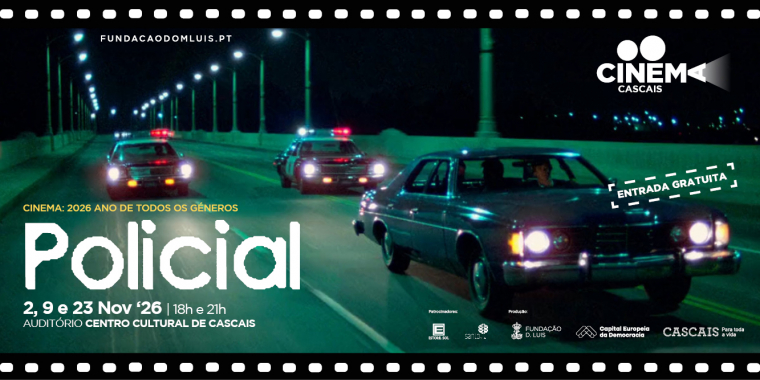
Cinema Cascais: Crime Film Series
The central theme of the crime film is crime — the criminal act that disrupts social order and violates the rules of the society to which the perpetrator of this deviant behavior belongs: in most cases, the perpetrator is unknown, and order is restored when a law enforcement agent — a lawyer, private detective, or police officer—manages to unravel the plot of the crime. The typology of the detective novel was defined by Tzvetan Todorov in terms that can be easily transposed to the typology of its cinematic counterpart:¹ there is, for example, the “mystery film,” in which the story of the crime precedes the narrative’s unfolding, and the characters, rather than taking action, convey information useful to the investigation: see *Rebecca* (1940), by A. Hitchcock.
The second type of narrative identified by Todorov corresponds to “film noir,” in which the story of the crime intertwines with that of the investigation: there is no pre-existing crime, and the investigation begins only when it occurs — an event that can naturally be repeated and endanger the lives of one or more characters: see *Strangers on a Train*, also by A. Hitchcock. The third type, which Todorov calls the “suspense novel,” blends the two types and is, in fact, also the most common in cinema: the crime precedes the narrative, as in the “mystery,” but there are other crimes that accompany the course of the investigation, as in “film noir,” and the narrative’s primary concern has less to do with the premises—which are, incidentally, explained — than with the events that unfold before the viewer’s eyes: consider *The Maltese Falcon*, an adaptation of D. Hammett’s masterful novel of the same name, or *The Big Sleep*, an adaptation of R. Chandler’s novel of the same name — two of the three most brilliant practitioners of the classic “roman noir” (the third is Ross McDonald).
Learn more,HERE.
Information: 214 815 660 and geral@fdl.pt
Organized by: D. Luís I Foundation, with the support of the Cascais City Council
The Maltese Falcon
(1941) Directed by: John Huston | Starring: Humphrey Bogart, Mary Astor, Peter Lorre, Sidney Greenstreet, Ward Bond, Elisha Cook Jr., Jerome Cowan, etc. | 100 minutes. Subtitled in Portuguese.
An adaptation of a stage play—which in turn was based on Mary Shelley’s classic novel of the same name—this film, along with Tod Browning’s *Dracula*, released the same year, established the horror movie genre and gave rise to the “monster parade” that brought so much glory to Universal. A “pre-Code” masterpiece and one of the high points of Whale’s artistry—a filmmaker of “gods and monsters”—it made the unsurpassed Boris Karloff (in a role originally sought by his rival Bela Lugosi, who portrayed the creature as both frightening and touching—innocently childlike, yet capable of animalistic rage) an instant star—and if the character is part of our collective imagination, due credit must be given to Jack Pierce’s makeup effects, which remain fantastic to this day—and invented archetypes such as the egomaniacal, mad scientist and his hunchbacked assistant. A visually sumptuous work, permeated by an undercurrent of dark humor typical of the director’s subversive poetry, which would only become more evident in the even more staggering sequel, *Bride of Frankenstein*. Come what may—all the remakes, imitations, and parodies—of this film we will always exclaim: “It’s alive!”
The Big Sleep
(1946) Directed by Howard Hawks | Starring: Humphrey Bogart, Lauren Bacall, John Ridgely, Martha Vickers, Dorothy Malone, Peggy Knudsen, Elisha Cook Jr., etc. | 114 minutes. Subtitled in Portuguese.
This is a very complex “story,” brought to life with great vitality (largely due to the dialogue by William Faulkner and Leigh Brackett, the cinematography by S. Hickox, and the score by Max Steiner, which together create countless scenes that are difficult to piece together on a first viewing of the film), in which the actors themselves stated that they had worked without fully understanding the plot, and Chandler noted clear changes from his original work, though he still expressed a positive opinion. *The Big Sleep*, which had an interesting sequel directed by Michael Winner and starring Robert Mitchum, is now considered a cult classic, and certain scenes—such as Marlowe’s encounter with the general in the stifling heat of the greenhouse or the dialogue laden with subtext between Marlowe and the bookseller—more so than the film as a whole, belong, for Bogart’s countless admirers, to the marvelous legend of cinema.
The French Connection
(1971) Directed by William Friedkin | Starring: Gene Hackman, Fernando Rey, Roy Scheider, Tony Lo Bianco, Marcel Bozzuffi, Frederic De Pasquale, Bill Hickman, Ann Rebbot, etc. | 110 minutes. Subtitled in Portuguese.
When it was released, the film was a colossal box-office hit and won two Oscars—awarded to the director and the lead actor— but it sparked a fierce campaign in the press, both in America (for reasons of social acceptability) and in Europe (for ideological reasons). Rediscovered by *Cahiers du cinéma*, Friedkin came to be regarded as one of Hollywood’s finest filmmakers, despite his frequent flops, with works centered on the portrayal of a solitary and elusive man, always portrayed with profound accuracy. *The French Connection* conceals, beneath a documentary-style veneer, the traditional structure of a gangster story, complete with the relative mythologizing of the villain. The almost hyper-realistic tones of the setting are largely attributable to Owen Roizman’s cinematography (panoramic, Gevacolor) and Jerry Greenberg’s edgy and tight editing.
Dirty Harry
(1971) Directed by Don Siegel | Starring: Clint Eastwood, Harry Guardino, Reni Santoni, John Vernon, Andrew Robinson, John Larch, John Mitchum, etc. | 102 minutes. Subtitled in Portuguese.
Poetry of violence, yet without relying on violence—that was always what Siegel sought to achieve: to be, in a sense, a poet of the moral contradictions of the lone hero who seeks to uphold justice in a society that remains indifferent to the suffering of ordinary citizens—a poet of images who was schooled by Walsh, Curtiz, Wood, Litvak, and Hawks—masters for whom he served as an assistant director in the 1940s and who, like him, acquired cinematic skill by working across different genres. From these positive influences, Siegel knew how to draw upon the art of blending film noir and the Western—a fusion he entrusted to Inspector Callahan in *Dirty Harry*, a character in whom one can discern the light shadows of the monomaniacal bounty hunter conceived by Anthony Mann in *The Man from Laramie* (1955), the vengeful pursuer of Native Americans portrayed by John Ford in *The Searchers* (1956), and, most notably, the sheriff betrayed by his fellow citizens conceived by Fred Zinnemann in *High Noon* (1952).
Clearly based on these impressive protagonists, Harry Callahan is not, however, a mere replica (or simulacrum) of them, but rather their metropolitan evolution: the gunslinger who, back in the 1870s, dispensed justice in territories acquired through the plundering of various Native American tribes, goes on to enforce the law in 1971 in a very peculiar city, San Francisco—an integral part of the capitalist United States, the most organized and stratified nation of the 20th century, where justice has been transformed into a bureaucratic and unproductive system. And it is worth noting that, to give his hero even more depth, Siegel knew how to make the most of the experience Clint Eastwood had gained in all the spaghetti westerns he starred in under Sergio Leone’s baroque direction, as well as the training he received from playing the lead role in *Coogan’s Bluff* (1968–69), a film directed by Siegel himself.
The Driver
(1978) Directed by Walter Hill | Starring: Ryan O’Neal, Bruce Dern, Isabelle Adjani, Ronee Blakley, Felice Orlandi, Matt Clark, Joseph Walsh, etc. | 91 minutes. Subtitled in Portuguese.
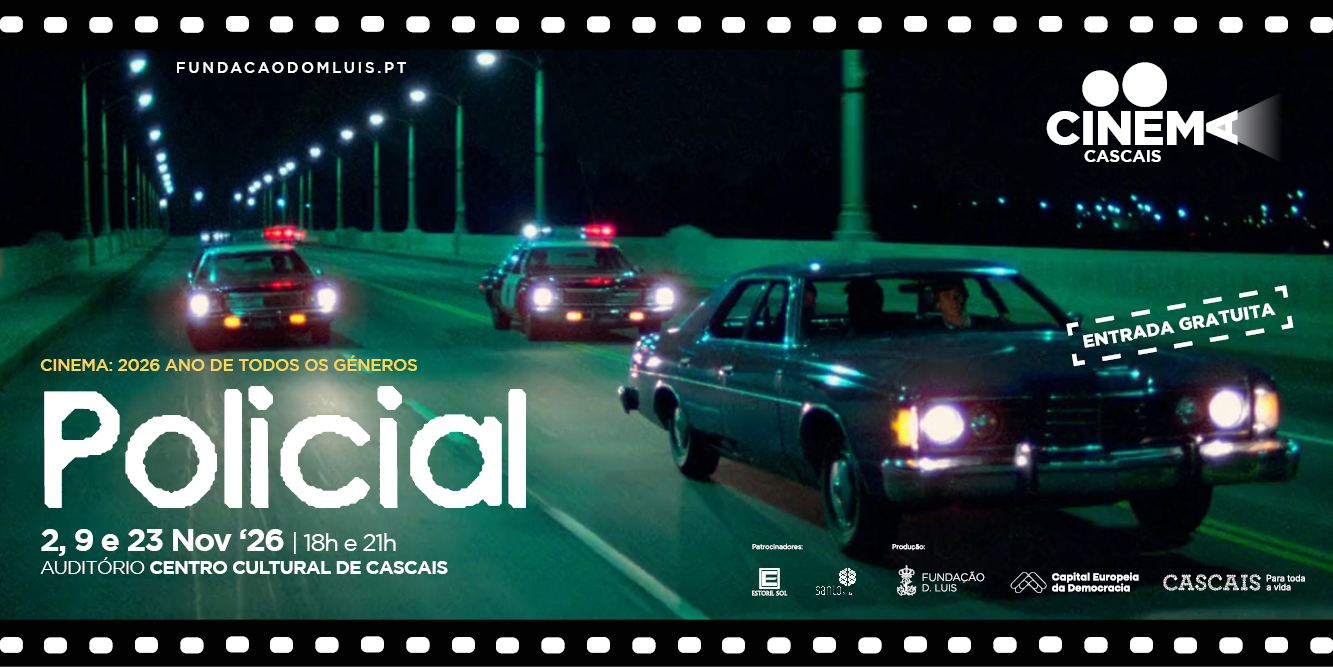
There is no shortage of reasons to find this concise and straightforward film by Walter Hill (another filmmaker whom Portuguese critics were slow to recognize as an auteur) interesting (and worthy of appreciation), as it dispenses with frills and irrelevant embellishments. Ryan O’Neal plays a professional getaway driver, and Bruce Dern plays a detective obsessed with catching him. Isabelle Adjani plays a beautiful young woman—as one might expect—who finds herself caught up in the events. The director, as in his other films (see the masterful *The Warriors* from 1979, an adaptation of Sol Yurick’s novel of the same name), places the viewer in the midst of a duel (a series of clashes), in which there is practically no dialogue, the characters have no names, and the setting provides the ideal backdrop for the actions projected on screen to be sufficiently evocative. This austerity of form does not detract from the appeal of the narrative structure or the development of the main characters. The simple plot—the typical clash between thief and law enforcement officer—demonstrates that less is more when one knows what one wants to achieve in storytelling; one cannot fail to mention the remarkable car chase sequences. Here, then, is a secret, fascinating, austere, poetic, and—it should be noted—quite existentialist film.
Some have labeled it a Bressonian film noir that leaves the viewer breathless: a landmark so essential that it has been copied, plagiarized, and admired time and time again. Behind the camera and seated at the typewriter was a young, talented screenwriter and director trained in the school of Hawks, Ford, Hitchcock, Lang, and Walsh—to speak of Americans and Americanized Europeans—but also in that of Renoir, Becker, Melville, and, most especially, his acknowledged master, Robert Bresson, to whom he could have dedicated this film, just as another Melville, this Herman, did with Hawthorne, placing this phrase before the opening credits: “In token of my admiration, I dedicate this film to Robert Bresson.”